The Third Umpire

Where Caribbean Cricket Meets Global Conversation.

Menu
  • Get Started Here
  • Join the Conversation
    • About
    • THINGS I LOVE TO DO
    • Did You Know
  • Third Umpire Blog
  • Our Services
    • Life Coaching & Stress Management
    • Get In Touch With Us
  • Shop Best Sellers
  • World Cup Football Facts
Menu

Third Umpire Blog

🏏Unsung Heroes of Caribbean Cricket – Part 3

Posted on September 20, 2025June 6, 2026 by Harold Gittens

The Caribbean has produced cricketing giants whose names echo across generations. Yet, beneath the towering legends lies a group of players who, though less celebrated, made meaningful contributions to West Indies cricket. This series highlights those “unsung heroes” — players who represented skill, resilience, and passion for the game, even if they never reached superstar status.

Alvin Greenidge

A stylish opening batsman from Barbados, Alvin Greenidge played only a handful of Tests in the late 1970s, overshadowed by the presence of Gordon Greenidge (no relation) and Desmond Haynes. Despite limited opportunities, his elegant stroke play showed glimpses of what could have been a longer international career.

Maurice Foster

The Jamaican all-rounder Maurice Foster had both batting skill and useful off-spin. His Test career was sporadic during the late 1960s and early 1970s, but he often played important roles for Jamaica in regional cricket, anchoring the middle order and providing balance with the ball.

Rolston Otto

From Antigua, Rolston Otto was a consistent performer for the Leeward Islands during the 1980s. A determined middle-order batsman, he never broke into the West Indies senior side, but his reliability at regional level made him a respected figure among his peers.

Winston Benjamin

An Antiguan fast bowler, Winston Benjamin came through during the late 1980s as part of the fierce West Indian pace tradition. Though not as menacing as Ambrose or Walsh, Benjamin’s accuracy and bounce earned him over 60 Test wickets. He later became a mentor for younger Antiguan players, including Curtly Ambrose.

Rafik Jumadeen

One of Trinidad and Tobago’s most notable left-arm spinners, Rafik Jumadeen played a single Test for the West Indies in 1972. At a time when pace dominated selection, his opportunities were scarce, but in regional cricket he was a constant threat, especially on turning tracks.

Clyde Butts

Guyana’s Clyde Butts was a steady off-spinner who played seven Tests in the 1980s. His international career was limited due to the West Indies’ fast-bowling supremacy, but he later contributed immensely as a selector, shaping the next generation of West Indian cricketers.

Robert Haynes

Known for his clever leg-spin and gritty batting, Jamaican Robert Haynes was a versatile all-rounder who represented the West Indies in ODIs during the late 1980s and early 1990s. He was among the few Caribbean leg-spinners to succeed at the regional level, paving the way for later wrist-spinners.

Robert Samuels

The brother of Marlon Samuels, Robert Samuels had a short but impactful Test career in the mid-1990s. A composed left-handed opener, he scored a crucial half-century in the famous Bridgetown Test of 1996, where West Indies chased down 311 against Australia. His calm presence provided stability in a fragile batting lineup.


Closing Thoughts

These men may not appear in cricket’s folklore alongside Richards, Sobers, or Lara, but their stories form part of the broader fabric of Caribbean cricket. They played with pride, carried their nations’ hopes, and left legacies that deserve to be remembered.

Leave a Reply Cancel reply

Your email address will not be published. Required fields are marked *


Keep Updated Subscribe to Our Blog

Don't Want to Miss an Article Subscribe to Stay Updated.

Subscribe to Keep Updated
Loading...

🎨Signature Strokes of West Indian Cricketers

Posted on September 13, 2025September 14, 2025 by Harold Gittens

The artistry of West Indies cricket is not only about power and dominance but also about the sheer elegance of stroke play. Some strokes became trademarks of Caribbean legends. Here’s a look at the West Indian masters of the hook, the late cut, and the square cut.


🔥 The Hook Shot Masters

Few cricketers played the hook with as much swagger as the West Indians. Facing the world’s fastest bowlers, they turned a defensive shot into an attacking weapon.

  • Sir Vivian Richards – Ferocious and fearless, hooked with dominance and authority.
  • Gordon Greenidge – Loved the short ball, hammered hooks with commanding presence.
  • Brian Lara – Elegant and wristy, guided the hook with precision and flair.
  • Clive Lloyd – Towering figure who unleashed the hook with sheer brute force.

🎯 The Late Cut Specialists

The late cut is about touch, timing, and finesse — areas where several Caribbean batsmen excelled.

  • Rohan Kanhai – Inventive and wristy, perfected the delicate late cut.
  • Alvin Kallicharran – Brilliant manipulator of pace and spin, late cut was his signature.
  • Shivnarine Chanderpaul – Patient and gritty, guided bowlers to third man with control.
  • Ramnaresh Sarwan – Elegant stroke-maker, used the late cut effectively in Tests.

⚡ The Square Cut Kings

Explosive, precise, and often unstoppable — the square cut has long been a West Indian favorite.

  • Brian Lara – Trademark shot, executed with lightning-quick hands.
  • Sir Garfield Sobers – Combined power and grace in the square cut.
  • Desmond Haynes – Compact, authoritative, punished anything short and wide.
  • George Headley (“The Black Bradman”) – Legendary pre-war master of the square cut.

🌴 Final Word

From Richards’ ferocious hook to Kanhai’s delicate late cut and Lara’s electrifying square cut, these strokes define the artistry of West Indian batting. They symbolize not just runs, but the flair and swagger of Caribbean cricket.

Leave a Reply Cancel reply

Your email address will not be published. Required fields are marked *

Subscribe to Our Blog

Dont Miss an Article

Subscribe

🏏The Caribbean Islands Ranked by Their Greatest Test Players

Posted on September 12, 2025September 22, 2025 by Harold Gittens

🥇 1. Barbados – The Cricketing Powerhouse

Barbados has produced the largest number of world-class Test cricketers, covering every era of West Indies cricket.
Legends from Barbados:

  • Sir Garfield Sobers – the greatest allrounder of all time
  • Sir Frank Worrell, Sir Clyde Walcott, Sir Everton Weekes (The Three Ws)
  • Malcolm Marshall – fearsome fast bowler
  • Joel Garner – “The Big Bird”
  • Gordon Greenidge & Desmond Haynes – iconic opening pair
  • Wes Hall, Charlie Griffith, Kemar Roach

Barbados is unmatched in depth and consistency.


🥈 2. Jamaica – Land of the Black Bradman and Fast Men

Jamaica has given the world some of the most elegant batsmen and quickest bowlers.
Legends from Jamaica:

  • George Headley – “The Black Bradman”
  • Michael Holding – “Whispering Death”
  • Courtney Walsh – record-breaking fast bowler
  • Chris Gayle – explosive Test and T20 opener
  • Lawrence Rowe – stylish but unfulfilled talent

Jamaica is second only to Barbados in terms of impact.


🥉 3. Trinidad & Tobago – Batting Flair and Spin Craft

Trinidad has a rich legacy of elegant stroke-makers and tricky spinners.
Legends from T&T:

  • Brian Lara – world record holder (375 & 400*)
  • Sonny Ramadhin – spin pioneer
  • Ian Bishop – strike fast bowler of the 1990s
  • Deryck Murray – reliable wicketkeeper
  • Darren Bravo – stylish modern batsman

Lara alone puts T&T in the top three.


🏅 4. Guyana – Home of Elegant Stroke-Makers

Guyana has produced some of the most stylish and dependable batsmen in West Indies history.
Legends from Guyana:

  • Clive Lloyd – captain of the invincible 1970s/80s side
  • Rohan Kanhai – innovative batsman, Lara’s idol
  • Alvin Kallicharran – classy left-hander
  • Shivnarine Chanderpaul – 11,000+ Test runs
  • Lance Gibbs – legendary off-spinner

Guyana’s influence on batting and leadership is enormous.


🏅 5. Antigua & Barbuda – Small Island, Big Impact

Despite its small size, Antigua has punched far above its weight.
Legends from Antigua:

  • Sir Vivian Richards – the most dominant batsman of his era
  • Sir Andy Roberts – master of fast bowling variations
  • Curtly Ambrose – one of the greatest fast bowlers ever
  • Richie Richardson – stylish stroke-player and captain

Few islands can match Antigua’s pound-for-pound impact.


🏅 6. St. Lucia, St. Vincent, Dominica, Grenada (Windward Islands)

Though smaller in number, these islands have produced gems.

  • Darren Sammy (St. Lucia) – inspirational captain in T20s
  • Winston Davis (St. Vincent) – ODI hat-trick man
  • Shane Shillingford (Dominica) – spinner
  • Junior Murray (Grenada) – wicketkeeper

Their Test legacy is smaller but still valuable.


🏆 Final Ranking

  1. Barbados – The most consistent and deepest pool of legends
  2. Jamaica – The Black Bradman + elite fast bowlers
  3. Trinidad & Tobago – Brian Lara and spin pioneers
  4. Guyana – Clive Lloyd, Chanderpaul, and stylish batsmen
  5. Antigua & Barbuda – Viv Richards, Ambrose, and Roberts
  6. Windward Islands (St. Lucia, St. Vincent, etc.) – fewer, but notable contributors.

Leave a Reply Cancel reply

Your email address will not be published. Required fields are marked *

Keep Updated Subscribe to Our Blog

Don't Want to Miss an Article Subscribe to Stay Updated.

Subscribe to Keep Updated
Loading...

🏏 Dream Match: West Indies XI vs Rest of the World XI

Posted on September 12, 2025February 19, 2026 by Harold Gittens

🌴 West Indies All-Time XI

Openers:

  1. Gordon Greenidge
  2. Desmond Haynes

Middle Order:
3. George Headley
4. Brian Lara
5. Sir Vivian Richards (c)

All-Rounder:
6. Sir Garfield Sobers

Wicketkeeper:
7. Clyde Walcott (wk)

Fast Bowlers:
8. Malcolm Marshall
9. Curtly Ambrose
10. Joel Garner
11. Michael Holding


🌍 Rest of the World All-Time XI

Openers:

  1. Sunil Gavaskar (Ind)
  2. Matthew Hayden (Aus)

Middle Order:
3. Sir Donald Bradman (Aus)
4. Sachin Tendulkar (Ind)
5. Jacques Kallis (SA)

Wicketkeeper:
6. Adam Gilchrist (Aus)

All-Rounder / Captain:
7. Imran Khan (Pak) (c)

Bowlers:
8. Shane Warne (Aus)
9. Muttiah Muralitharan (SL)
10. Wasim Akram (Pak)
11. Glenn McGrath (Aus)


⚔️ Key Match-Ups

  • Greenidge & Haynes vs Wasim & McGrath → Firepower vs precision swing.
  • Lara & Richards vs Warne & Murali → Flair vs spin wizardry.
  • Sobers vs Kallis & Imran → Two of the greatest all-rounders clash.
  • Marshall, Holding, Garner & Ambrose vs Bradman, Sachin, Gavaskar → Pace battery vs batting immortals.

🏆 Who Wins?

  • West Indies: Relentless pace attack, match-turning flair from Lara, Richards & Sobers.
  • Rest of World: Bradman-led batting fortress, spin dominance of Warne & Murali, backed by Wasim’s swing & McGrath’s control.

👉 This is the ultimate cricket fantasy clash — a battle of swagger, skill, and supremacy. 🌴🔥🌍

Leave a Reply Cancel reply

Your email address will not be published. Required fields are marked *

🏏Did You Know? – West Indies Legends You Might Have Forgotten

Posted on September 11, 2025March 24, 2026 by Harold Gittens

Did You Know? – West Indies Legends You Might Have Forgotten

Cricket in the Caribbean has always been rich with larger-than-life characters, match-winners, and pioneers who shaped the game in ways we sometimes take for granted. Some names are celebrated endlessly—Richards, Sobers, Lara, Holding—but behind them lie figures whose contributions are equally fascinating.

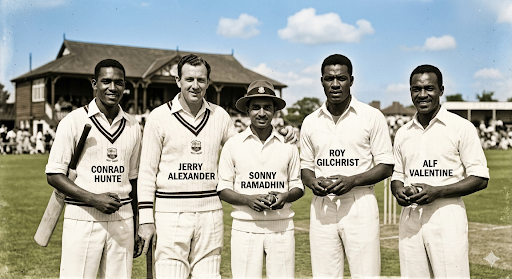
In this installment of our “Did You Know?” series, we spotlight five such men: Roy Gilchrist, Alf Valentine, Sonny Ramadhin, Conrad Hunte, and Gerry Alexander.


🏏 Roy Gilchrist – The Fiery Fast Bowler

Did you know Roy Gilchrist was one of the fastest bowlers the West Indies ever produced, yet played only 13 Tests?
His pace—often clocked at over 90 mph in the 1950s—left batsmen shaken, but his fiery temper sometimes overshadowed his brilliance. Gilchrist’s international career ended abruptly. His raw speed helped set the tone for the fearsome West Indian pace tradition that would dominate world cricket years later.


🏏 Alf Valentine – The Man Who Spun History

Did you know Alf Valentine went from schoolboy cricket in Jamaica to destroying England in the space of one tour?
Alongside Sonny Ramadhin, Valentine bowled West Indies to their first-ever Test series victory in England (1950), claiming 33 wickets and tormenting batsmen with relentless spin. His exploits inspired the famous calypso: “Cricket, lovely cricket, at Lord’s where I saw it.”


🏏 Sonny Ramadhin – A Pioneer of Heritage and Skill

Did you know Sonny Ramadhin was the first player of East Indian descent to represent West Indies?
Ramadhin’s wrist spin and subtle variations bamboozled batsmen on the 1950 England tour, where he took 26 wickets. Beyond statistics, Ramadhin became a symbol of representation, showing the Caribbean’s diversity on the international stage.

Check Out This Affordable Projector

🏏 Conrad Hunte – Grace and Determination at the Crease

Did you know Conrad Hunte combined elegance with resilience, becoming one of West Indies’ finest opening batsmen?
He scored more than 3,000 Test runs at an impressive average of 45. Off the field, Hunte dedicated himself to the Moral Re-Armament movement, proving that cricketing excellence could be paired with a life of principle and service.


🏏 Gerry Alexander – The Last White Captain of the West Indies

Did you know Gerry Alexander was the last white man to captain the West Indies?
A calm wicketkeeper-batsman, Alexander’s leadership came at a pivotal time, including during the famous 1960 tied Test at Brisbane. He was a steady hand in a changing era, bridging the gap as West Indies cricket embraced new leadership and identity.


🌴 Closing Thought

From Gilchrist’s fire to Valentine and Ramadhin’s spin, from Hunte’s elegance to Alexander’s leadership, each of these men left an indelible mark on West Indies cricket. Their stories remind us that cricket’s history isn’t just about statistics—it’s about culture, character, and legacy.

Stay tuned for the next chapter in our “Did You Know?” series, where we continue uncovering the forgotten gems of Caribbean cricket.


Leave a Reply Cancel reply

Your email address will not be published. Required fields are marked *

🏏Let’s Go Down Memory Lane: The 1960 Tied Test at the Gabba in Brisbane Australia

Posted on September 11, 2025September 29, 2025 by Harold Gittens

The first test between Australia and the West Indies in the series was play at the Gabba in Brisbane. The year was 1960, quite a long time ago. I was one year old so I dont think my memory cells were sufficiently developed to have a clue that there was even a game called cricket.

Many cricket fans who would have read about this game or heard from their parents would agree with their take on that match. Many say it was and still is; one the the greatest matches ever played.

The two captains Richie Benaud and Frank Worrell each declared that the game was the most exciting match in which they have ever played. Sir Donald Bradman who was chairman of the Australian Cricket Board describe the game as “the greatest and most exciting of all time.”

Here’s how that day in 1960 and the game unfolded:

The Brisbane Cricket Ground, December sun blazing down. A sea of 90,000 voices surged, knowing they were witnessing something that would echo through time. The West Indies, led by the regal Frank Worrell, carried not just skill but a sense of pride, grace, and steel. Facing them, Australia under the wily Richie Benaud, determined, calculating, and unwilling to let history slip away.

West Indies’ first innings:

The calypso flair was on full display. Conrad Hunte stroked a polished 116, while the majestic Garry Sobers, young but already a phenomenon, carved 132 with strokes that dripped with brilliance. Wes Hall, tall and terrifying, later charged in with thunderbolts, his pace shaking the Australians to their core.

Australia’s reply:

Enter Norm O’Neill — stylish, unflappable. His 181 was an innings of silk and steel, carrying Australia within touching distance of parity. Alan Davidson, limping, bruised, but lion-hearted, fought for every run, a man refusing to yield to pain.

The climax — Australia’s chase of 233 in the fourth innings:

The crowd crackled with tension. Worrell marshalled his men like a general at war. Hall, exhausted but possessed by fire, bowled over after over, his shirt clinging to his back. Benaud countered with daring cuts and drives, eyes blazing with resolve.

The scoreboard tightened. Australia edged closer. Davidson, again the warrior, lashed boundaries despite his injuries. Every wicket was greeted by roars, every boundary by gasps. The clock, the crowd, the players — all seemed to pulse as one.

And then, the final over. Australia needed 6 runs, 1 wicket in hand. Hall pounding in, sweat pouring, his legs barely carrying him. Davidson was run out. The scores level. One wicket left. The very next ball — Hall thundered in, a blur, the crowd holding its breath. Ian Meckiff pushed, scampered, and chaos erupted — run out!

The scoreboard froze: Australia 232 all out. Match tied.

Not victory, not defeat. Something rarer. Something immortal. Players from both sides, exhausted and exultant, embraced in the middle. In that moment, cricket had written poetry in sweat, dust, and courage.

The cast of immortals that day:

• West Indies: Frank Worrell (c), Conrad Hunte, Rohan Kanhai, Garry Sobers, Joe Solomon, Gerry Alexander (wk), Denis Atkinson, Wes Hall, Alf Valentine, Sonny Ramadhin, Roy Gilchrist.

• Australia: Richie Benaud (c), Bob Simpson, Colin McDonald, Norm O’Neill, Neil Harvey, Wally Grout (wk), Alan Davidson, Ken Mackay, Lindsay Kline, Ian Meckiff, Garth McKenzie.

Was it the greatest match ever played? What are your memories of the game?

Leave a Reply Cancel reply

Your email address will not be published. Required fields are marked *


Keep Updated Subscribe to Our Blog

Don't Want to Miss an Article Subscribe to Stay Updated.

Subscribe to Keep Updated
Loading...

Read More Subscribe

🏏The Three Primary Causes of Stress and Depression in Today’s Society—and How to Cope

Posted on September 10, 2025September 25, 2025 by Harold Gittens

Stress and depression are no longer rare conditions affecting a few—they have become almost universal experiences. In today’s fast-moving, pressure-filled world, millions of people struggle to balance responsibilities, expectations, and emotions. Although the causes are many, three issues repeatedly rise to the surface: financial pressure, workplace stress, and relationship strain. Let’s look at each of these in detail and explore practical strategies to cope with them.


1. Financial Pressure: The Weight of Money Troubles

Money worries are the number one source of stress worldwide. From unpaid bills to mounting credit card debt, financial pressure creeps into every corner of life. Advertising constantly pushes us to want more, social media flaunts luxury lifestyles, and easy access to credit makes overspending almost effortless.

Over time, this cycle of wanting, spending, and owing can lead to chronic stress. The burden of debt not only affects our mental health but also causes physical symptoms like insomnia, headaches, and high blood pressure. In severe cases, financial distress can lead to broken relationships and legal troubles.

Coping Strategies for Financial Stress

  • Create a realistic budget: Track your income and expenses honestly. A written plan reduces uncertainty and gives you back control.
  • Prioritize essentials: Focus on needs—housing, food, healthcare—before wants.
  • Build an emergency fund: Even small, consistent savings reduce the fear of unexpected expenses.
  • Seek financial advice: A coach or advisor can help restructure debt and create repayment strategies.
  • Limit social comparison: Remember that the glamorous lifestyles you see online often mask real financial struggles.

2. Workplace Stress: Pressure on the Job

For many, the workplace is the second biggest source of stress. Whether it’s harsh working conditions, demanding bosses, or unrealistic targets, job stress can quickly escalate. Employees are expected to deliver more in less time, compete fiercely, and adapt to rapidly changing technologies.

The rising cost of living only intensifies this stress—people feel trapped in jobs they dislike because they can’t afford to walk away. Prolonged workplace stress not only drains motivation but also contributes to burnout, anxiety, and even depression.

Coping Strategies for Workplace Stress

  • Set boundaries: Learn to say no when demands exceed your capacity. Protect your evenings, weekends, and rest time.
  • Break tasks into steps: Large projects can feel overwhelming. Smaller, manageable goals create momentum.
  • Communicate openly: Share concerns with supervisors or colleagues rather than bottling them up.
  • Practice stress management: Techniques like deep breathing, mindfulness, or short breaks during the day can reset your focus.
  • Look at long-term options: If a job is toxic, start building skills or connections that will help you transition to a healthier work environment.

3. Relationship Strain: Tension Close to Home

Human beings are wired for connection, but relationships can also become one of the heaviest sources of stress. Arguments with a partner, conflicts with family, or friendships under strain all affect emotional well-being.

In modern society, fast-paced living and shifting cultural values make relationships harder to sustain. Couples may have less time together, families may live further apart, and digital communication sometimes replaces face-to-face connection. Misunderstandings, unmet expectations, and lack of trust often lead to ongoing tension that erodes mental health.

Coping Strategies for Relationship Stress

  • Improve communication: Be honest about needs and feelings, and listen actively without judgment.
  • Set healthy boundaries: Protect your emotional space by defining what behavior is and isn’t acceptable.
  • Practice empathy: Try to see the situation from the other person’s perspective.
  • Seek counseling or mediation: A neutral professional can help couples and families resolve deep-rooted conflicts.
  • Invest in quality time: Strengthen bonds through shared experiences rather than material distractions.

Moving Forward: Building Resilience

While money, work, and relationships will always bring some degree of stress, the goal is not to eliminate challenges but to manage them more effectively. Building resilience—through healthy routines, emotional awareness, and strong support systems—helps prevent stress from turning into depression.

General Tips for Stress Management

  • Exercise regularly: Physical activity is a natural stress reliever.
  • Maintain a balanced diet: Good nutrition supports both mental and physical health.
  • Sleep well: Rest is essential for emotional regulation and decision-making.
  • Cultivate hobbies: Creative or relaxing activities help reset the mind.
  • Build support networks: Friends, mentors, or community groups provide perspective and encouragement.

Final Thoughts

Stress and depression are complex, but by understanding their primary sources—financial struggles, workplace demands, and relationship tensions—we can take proactive steps to manage them. Each person’s situation is unique, yet the principles of budgeting, boundary-setting, communication, and self-care are universal tools.

By addressing these issues head-on and developing healthier coping mechanisms, we can reduce the hold stress has over our lives and create space for greater peace, resilience, and fulfillment.

Leave a Reply Cancel reply

Your email address will not be published. Required fields are marked *


Keep Updated Subscribe to Our Blog

Don't Want to Miss an Article Subscribe to Stay Updated.

Subscribe to Keep Updated
Loading...

🏏Left-Handed Opening Batsmen in the Caribbean: Are They More Impactful Than the Right-Handed Openers?

Posted on September 9, 2025September 26, 2025 by Harold Gittens

In cricket, the battle between left-handers and right-handers has always fascinated fans. The Caribbean has produced a proud legacy of openers who set the tone for some of the most dominant West Indies sides in history. But here’s the question: have the left-handed openers been more impactful than their right-handed counterparts?

The Caribbean has seen a string of left-handed openers who combined flair with firepower. Roy Fredericks was the fearless trendsetter of the 1970s, famously smashing a century against Dennis Lillee and Jeff Thomson at Brisbane. Decades later, Chris Gayle carried the torch with his explosive batting—three triple centuries in Tests, two T20 World Cup titles, and a reputation as the “Universe Boss.”


The Case for the Left-Handers

More recently, Evin Lewis has taken the mantle, blasting bowling attacks in T20 cricket with his six-hitting ability. Left-handers often bring a natural elegance and the ability to disrupt bowlers’ rhythm. Their impact has been undeniable in modern white-ball formats, where power and angles matter more than ever.


The Case for the Right-Handers

While left-handers grab the headlines, the backbone of West Indies opening partnerships has often been right-handers. Think of Desmond Haynes—rock solid, technically sound, and the perfect foil for Gordon Greenidge. Or Adrian Griffith and Sherwin Campbell, who offered grit in tougher eras.

Right-handers have historically provided stability at the top, wearing down new-ball attacks and giving flair players the platform to dominate. Haynes and Greenidge alone formed one of the most successful opening partnerships in Test history, proving that consistency sometimes matters more than flair.


Impact Beyond Numbers

Left-handers may seem more impactful because their style is often more eye-catching: flamboyant cuts, booming drives, and fearless sixes. But right-handers have arguably been more consistent over time, ensuring the West Indies had solid starts in both Tests and ODIs.

Perhaps the true magic lay in the combination—a left-right mix that unsettled bowlers and gave the team balance. Greenidge (right) and Haynes (right) were exceptions as two righties, but when paired with left-handers like Fredericks or Gayle in later eras, the Caribbean often found the perfect blend of steadiness and aggression.


So, Who’s More Impactful?

If we judge by spectacle and global impact, left-handers like Gayle and Fredericks shine brightest. But if we measure by longevity and success as partnerships, the right-handers—especially Haynes and Greenidge—have the stronger case.

The truth? Caribbean cricket needed both: the left-handers to dazzle and disrupt, the right-handers to anchor and accumulate. Together, they wrote some of the greatest chapters in West Indies cricket history.

Leave a Reply Cancel reply

Your email address will not be published. Required fields are marked *

Keep Updated Subscribe to Our Blog

Don't Want to Miss an Article Subscribe to Stay Updated.

Subscribe to Keep Updated
Loading...
Read More

🏏Unsung Heroes of Caribbean Cricket – Part 2

Posted on September 9, 2025February 7, 2026 by Harold Gittens

The West Indies cricket legacy isn’t built only on the famous names like Sobers, Richards, Lara, and Holding. Behind the legends stand dozens of cricketers who carried the flag with quiet dignity, giving their all even if history books rarely mention them. In this second edition of Unsung Heroes of Caribbean Cricket, we spotlight a handful of players who deserve their share of recognition.


Richard Gabriel

A right-handed batsman from Trinidad & Tobago, Richard Gabriel’s international career was brief—he played two Tests in 1984. Yet, his selection came at a time when West Indies cricket was packed with batting giants, which shows just how much talent he possessed. Gabriel was also known as a steady performer in regional cricket, always ready to anchor an innings.


Leonard Baichan

The stylish Guyanese left-hander Leonard Baichan made his Test debut in 1975 against Pakistan and scored a patient 105 not out. Despite that brilliant start, he never cemented his place in a batting order crowded with world-class names. His grit and elegance made him a local hero, even if he remains one of the “forgotten centurions” of West Indies cricket.


Basil Williams

From Jamaica came Basil Williams, a gutsy opener who played in the late 1970s and early 80s. He is remembered for scoring a century on Test debut against Australia in 1978—a rare achievement. Williams was also a fighter during the Packer era, holding his own against top-class attacks when the West Indies needed stability.


Clayton Lambert

Clayton Lambert’s story spans both ends of a career—he represented the West Indies in the 1990s, then later Guyana again in the 2000s, even making a comeback at 42 to play for the United States. Known for his aggressive left-handed batting, Lambert was a fearless stroke-maker who never shied away from taking on the best bowlers.


Faoud Bacchus

Another Guyanese talent, Faoud Bacchus, is remembered for his elegant batting and his ability to grind out long innings. His finest hour came against India in 1979, when he scored a memorable 250 in Delhi. Though his Test career was short, Bacchus showed glimpses of class that could have flourished in a different era.


Stuart Williams

Stuart Williams of St. Kitts was a loyal servant to West Indies cricket during the 1990s and early 2000s. Though he never became a superstar, he was a dependable top-order batsman who often weathered the storm against tough new-ball attacks. His 128 against Zimbabwe in 1997 remains a standout innings.


Geoffrey Greenidge

Geoffrey Greenidge of Barbados had a short Test career in the early 1970s, playing five matches. A technically sound opener, he was seen as a bright prospect, but his international journey ended early due to political controversy after he played in South Africa during the apartheid era. Despite this, he remained a respected figure in regional cricket circles.


Continue reading “🏏Unsung Heroes of Caribbean Cricket – Part 2”

What Some of the Best Bowlers in the Game say About Great Batsmen

Posted on September 8, 2025September 14, 2025 by Harold Gittens

Great bowlers often have a deep respect for great batsmen, recognizing their skill, temperament, and the challenges they present on the field. Here are some insights from famous bowlers on what they think about the best batsmen:

1. Shane Warne on Sachin Tendulkar

Warne, one of the greatest leg spinners in cricket history, had a lot of admiration for Sachin Tendulkar. He once famously said:

  • “The thing with Sachin is that he has the ability to play every delivery, every line, every length with equal ease.”
    Warne also described Tendulkar as a “genius,” emphasizing his consistency and ability to adapt to any bowler or situation.

2. Glenn McGrath on Ricky Ponting

McGrath, known for his accuracy and relentless line and length, spoke highly of his Australian teammate and captain, Ricky Ponting:

  • “Ponting is the best batsman I’ve ever seen, especially in terms of consistency. He has the ability to dominate bowlers and turn the game in his team’s favor.”
    McGrath often mentioned how Ponting’s temperament and technical skill made him the ultimate batsman in any format.

3. Wasim Akram on Brian Lara

The “Sultan of Swing” has praised Brian Lara for his class and flair:

  • “Lara was a genius. He was so good at reading the game. No matter the bowler or the conditions, he always knew how to score runs, and he had this unique ability to dominate spinners and pacers alike.”

4. Muttiah Muralitharan on Adam Gilchrist

Muralitharan, who bowled to some of the greatest batsmen of his era, spoke highly of Adam Gilchrist:

  • “Gilchrist is one of the best because he plays with so much freedom, and he’s not afraid of getting out. But at the same time, he can make quick, game-changing runs when his team needs it the most.”

5. Curtly Ambrose on Rahul Dravid

The West Indian pacer Curtly Ambrose was often considered one of the most intimidating fast bowlers, but he had great respect for Rahul Dravid:

  • “Dravid is a true Test batsman. He is rock solid and doesn’t give his wicket away. He’s the kind of batsman who frustrates bowlers, and that’s the sign of a great player.”
    Ambrose, known for his lethal bounce and pace, admired Dravid’s technique and resilience.

6. Dale Steyn on Virat Kohli

South African speedster Dale Steyn, known for his fiery pace, has repeatedly mentioned how tough Virat Kohli is to bowl to:

  • “Kohli is probably the best in the world at chasing down scores. His mental strength and the way he handles pressure is what makes him stand out. As a bowler, you can’t let your guard down for a second when bowling to him.”

7. James Anderson on Steve Smith

James Anderson, England’s most successful fast bowler, has spoken about Steve Smith in awe:

  • “Steve Smith is one of the hardest players I’ve had to bowl to. His unorthodox technique makes him unpredictable, but it’s also a testament to his genius. He can adapt quickly and find a way to score, no matter how tough the conditions.”

8. Dennis Lillee on Sunil Gavaskar

The legendary Australian fast bowler Dennis Lillee had immense respect for India’s Sunil Gavaskar:

  • “Gavaskar was a master of the technique, a player with immense focus. He was never intimidated by pace or conditions, and that’s what made him a standout.”

Common Threads:

From all of these insights, there are a few common threads that great bowlers consistently praise in great batsmen:

  • Mental Strength: The ability to stay calm under pressure, adapt to changing conditions, and not give away one’s wicket easily.
  • Technique: Great batsmen are technically sound, whether it’s playing against fast bowlers, spinners, or in any conditions.
  • Adaptability: The best batsmen can adjust their game to any challenge, whether it’s the pitch, the opposition, or the match situation.
  • Fearlessness: Many bowlers admire batsmen who aren’t afraid to take risks when needed and dominate bowlers with confidence.

Do any of these quotes resonate with you, or is there a specific bowler-batsman combo that you find especially intriguing?

Leave a Reply Cancel reply

Your email address will not be published. Required fields are marked *

Read More

More Articles for You to Enjoy!

Read More

Subscribe

Keep Updated

Subscribe

  • Previous
  • 1
  • 2
  • 3
  • 4
  • Next

Hey! I'm Harold G

Harold M Gittens

My Voice in the Game We Love

I am a Sales Executive and Life Coach by profession, but at heart, I have always been a student and admirer of cricket. This game has given us unforgettable memories, uniting people across cultures, generations, and nations. Over the years, cricket has evolved—new formats have emerged, new heroes have risen—but at its core, it remains the game we love.

Through this platform, I want to add my voice to the conversation. Beyond scores and statistics, cricket is about stories, lessons, and the emotions it stirs in all of us. Here, I invite you to join me for meaningful discussions—about the sport’s past, present, and future. Together, we can celebrate the legends, debate the changes, and reflect on what cricket truly means to us as fans and as people.

Because cricket is not just a game. It’s a mirror of life itself—discipline, resilience, passion, and joy all rolled into one.

Coming Soon-Life Coaching & Stress Management

Motivational Quotes

"They may forget what you said buy they will never forget how you made them feel."

"Trust takes years to build, seconds to break and years to repair."

"The only person you should try to be better than is the person you were yesterday."

Recent Posts

  • Has the Present Brazil World Cup Team Lost the Flair of Past Teams
  • The Oldest Players at FIFA World Cup 2026
  • What West Indies Have Done Well So Far in the T20 World Cup and What will Keep the Momentum Going.
  • T20 World Cup 2026: Five Strategies that Can Help West Indies Win the Present T20 World Cup
  • Where Is the Plan? The Missing Ingredient in West Indies Cricket

The Third Umpire

The Oldest Players at FIFA World Cup 2026

The oldest players at the 2026 FIFA World Cup include several legendary veterans who are still representing their countries on the biggest stage. FIFA confirmed that Scotland goalkeeper Craig Gordon […]

Online Courses & Training

Teach English Online and around the Globe- World TESOL Academy

World TESOL Academy – Accredited TESOL/TEFL Certificate
IAP Career College
Affordable Online Certificate Courses at IAP Career College

TheTEFL Institute -Teach Online -TEFL Courses and Jobs

Amazon Deals

Amazon Echo Studio (newest model), compact design, immersive spatial audio and Dolby Atmos, Designed for Alexa+, Glacier White
PURE CHAMP Mens 3 Pack Fleece Active Athletic Workout Jogger Sweatpants for Men with Zipper Pocket and Drawstring - Size S-3XL

Privacy Policy

  • West Indies, New Zealand meet in Sobers' country to celebrate him
  • Garry Sobers dies, aged 89
  • Greaves and King return for final two ODIs against New Zealand
  • Lennox stars again as New Zealand take series lead after West Indies collapse
  • New Zealand bowl; West Indies bring in Shimron Hetmyer after long layoff

Menu

  • Get Started Here
  • Join the Conversation
    • About
    • THINGS I LOVE TO DO
    • Did You Know
  • Third Umpire Blog
  • Our Services
    • Life Coaching & Stress Management
    • Get In Touch With Us
  • Shop Best Sellers
  • World Cup Football Facts
Copyright ©2025 The Third Umpire. All Rights Reserved.