The Third Umpire

Where Caribbean Cricket Meets Global Conversation.

Menu
  • Get Started Here
  • Join the Conversation
    • About
    • THINGS I LOVE TO DO
    • Did You Know
  • Third Umpire Blog
  • Our Services
    • Life Coaching & Stress Management
    • Get In Touch With Us
  • Shop Best Sellers
  • World Cup Football Facts
Menu

Tag: caribbean cricket

🏏Let’s Go Down Memory Lane: The 1960 Tied Test at the Gabba in Brisbane Australia

Posted on September 11, 2025September 29, 2025 by Harold Gittens

The first test between Australia and the West Indies in the series was play at the Gabba in Brisbane. The year was 1960, quite a long time ago. I was one year old so I dont think my memory cells were sufficiently developed to have a clue that there was even a game called cricket.

Many cricket fans who would have read about this game or heard from their parents would agree with their take on that match. Many say it was and still is; one the the greatest matches ever played.

The two captains Richie Benaud and Frank Worrell each declared that the game was the most exciting match in which they have ever played. Sir Donald Bradman who was chairman of the Australian Cricket Board describe the game as “the greatest and most exciting of all time.”

Here’s how that day in 1960 and the game unfolded:

The Brisbane Cricket Ground, December sun blazing down. A sea of 90,000 voices surged, knowing they were witnessing something that would echo through time. The West Indies, led by the regal Frank Worrell, carried not just skill but a sense of pride, grace, and steel. Facing them, Australia under the wily Richie Benaud, determined, calculating, and unwilling to let history slip away.

West Indies’ first innings:

The calypso flair was on full display. Conrad Hunte stroked a polished 116, while the majestic Garry Sobers, young but already a phenomenon, carved 132 with strokes that dripped with brilliance. Wes Hall, tall and terrifying, later charged in with thunderbolts, his pace shaking the Australians to their core.

Australia’s reply:

Enter Norm O’Neill — stylish, unflappable. His 181 was an innings of silk and steel, carrying Australia within touching distance of parity. Alan Davidson, limping, bruised, but lion-hearted, fought for every run, a man refusing to yield to pain.

The climax — Australia’s chase of 233 in the fourth innings:

The crowd crackled with tension. Worrell marshalled his men like a general at war. Hall, exhausted but possessed by fire, bowled over after over, his shirt clinging to his back. Benaud countered with daring cuts and drives, eyes blazing with resolve.

The scoreboard tightened. Australia edged closer. Davidson, again the warrior, lashed boundaries despite his injuries. Every wicket was greeted by roars, every boundary by gasps. The clock, the crowd, the players — all seemed to pulse as one.

And then, the final over. Australia needed 6 runs, 1 wicket in hand. Hall pounding in, sweat pouring, his legs barely carrying him. Davidson was run out. The scores level. One wicket left. The very next ball — Hall thundered in, a blur, the crowd holding its breath. Ian Meckiff pushed, scampered, and chaos erupted — run out!

The scoreboard froze: Australia 232 all out. Match tied.

Not victory, not defeat. Something rarer. Something immortal. Players from both sides, exhausted and exultant, embraced in the middle. In that moment, cricket had written poetry in sweat, dust, and courage.

The cast of immortals that day:

• West Indies: Frank Worrell (c), Conrad Hunte, Rohan Kanhai, Garry Sobers, Joe Solomon, Gerry Alexander (wk), Denis Atkinson, Wes Hall, Alf Valentine, Sonny Ramadhin, Roy Gilchrist.

• Australia: Richie Benaud (c), Bob Simpson, Colin McDonald, Norm O’Neill, Neil Harvey, Wally Grout (wk), Alan Davidson, Ken Mackay, Lindsay Kline, Ian Meckiff, Garth McKenzie.

Was it the greatest match ever played? What are your memories of the game?
Leave a Reply Cancel reply

Your email address will not be published. Required fields are marked *


Keep Updated Subscribe to Our Blog

Don't Want to Miss an Article Subscribe to Stay Updated.

Subscribe to Keep Updated
Loading...

Read More Subscribe

🏏Left-Handed Opening Batsmen in the Caribbean: Are They More Impactful Than the Right-Handed Openers?

Posted on September 9, 2025September 26, 2025 by Harold Gittens

In cricket, the battle between left-handers and right-handers has always fascinated fans. The Caribbean has produced a proud legacy of openers who set the tone for some of the most dominant West Indies sides in history. But here’s the question: have the left-handed openers been more impactful than their right-handed counterparts?

The Caribbean has seen a string of left-handed openers who combined flair with firepower. Roy Fredericks was the fearless trendsetter of the 1970s, famously smashing a century against Dennis Lillee and Jeff Thomson at Brisbane. Decades later, Chris Gayle carried the torch with his explosive batting—three triple centuries in Tests, two T20 World Cup titles, and a reputation as the “Universe Boss.”


The Case for the Left-Handers

More recently, Evin Lewis has taken the mantle, blasting bowling attacks in T20 cricket with his six-hitting ability. Left-handers often bring a natural elegance and the ability to disrupt bowlers’ rhythm. Their impact has been undeniable in modern white-ball formats, where power and angles matter more than ever.


The Case for the Right-Handers

While left-handers grab the headlines, the backbone of West Indies opening partnerships has often been right-handers. Think of Desmond Haynes—rock solid, technically sound, and the perfect foil for Gordon Greenidge. Or Adrian Griffith and Sherwin Campbell, who offered grit in tougher eras.

Right-handers have historically provided stability at the top, wearing down new-ball attacks and giving flair players the platform to dominate. Haynes and Greenidge alone formed one of the most successful opening partnerships in Test history, proving that consistency sometimes matters more than flair.


Impact Beyond Numbers

Left-handers may seem more impactful because their style is often more eye-catching: flamboyant cuts, booming drives, and fearless sixes. But right-handers have arguably been more consistent over time, ensuring the West Indies had solid starts in both Tests and ODIs.

Perhaps the true magic lay in the combination—a left-right mix that unsettled bowlers and gave the team balance. Greenidge (right) and Haynes (right) were exceptions as two righties, but when paired with left-handers like Fredericks or Gayle in later eras, the Caribbean often found the perfect blend of steadiness and aggression.


So, Who’s More Impactful?

If we judge by spectacle and global impact, left-handers like Gayle and Fredericks shine brightest. But if we measure by longevity and success as partnerships, the right-handers—especially Haynes and Greenidge—have the stronger case.

The truth? Caribbean cricket needed both: the left-handers to dazzle and disrupt, the right-handers to anchor and accumulate. Together, they wrote some of the greatest chapters in West Indies cricket history.

Leave a Reply Cancel reply

Your email address will not be published. Required fields are marked *

Keep Updated Subscribe to Our Blog

Don't Want to Miss an Article Subscribe to Stay Updated.

Subscribe to Keep Updated
Loading...
Read More

🏏Tanti Merle at de Oval: A Legendary Caribbean Cricket Tale

Posted on September 7, 2025February 20, 2026 by Harold Gittens

Cricket in the Caribbean isn’t just a sport; it’s a celebration of life, culture, and community. One of the most iconic stories that encapsulate this spirit is Paul Keens-Douglas’s humorous account, Tanti Merle at de Oval. This tale takes us back to the 1975 Shell Shield match between Trinidad and Tobago and the Combined Islands at the Queen’s Park Oval in Port of Spain.

The story begins with the narrator’s wife requesting him to take her Aunt Merle, affectionately known as Tanti Merle, to the match on her 65th birthday. Originally from St. Vincent, Tanti Merle had been living in Trinidad for 15 years but had never attended a live cricket match. Determined to make her birthday special, the narrator reluctantly agrees.

The day starts with Tanti Merle packing a basket filled with food, insisting that no one would starve her in Port of Spain. The narrator, humorously recounting the events, describes how he ends up carrying the heavy basket. Their journey is filled with Tanti Merle’s anecdotes about St. Vincent, much to the amusement (and slight embarrassment) of the narrator.

Upon reaching the Queen’s Park Oval, the atmosphere is electric. The stands are packed, and the crowd is buzzing with excitement. Tanti Merle, ever the enthusiast, immerses herself in the match, cheering passionately for the Combined Islands. Her infectious energy adds to the vibrant ambiance of the game.

The Combined Islands are chasing a challenging target. The tension builds as wickets fall, but the crowd remains hopeful. Tanti Merle, with her unwavering support, becomes a symbol of the undying spirit of Caribbean cricket fans.

By the end of the match, the Combined Islands fall short, but the day is remembered not for the result but for the experience. Tanti Merle’s first live cricket match becomes a cherished memory, filled with laughter, camaraderie, and the essence of Caribbean culture.

 Trinidad and Tobago vs. Combined Leeward and Windward Islands – 1974/75 Season

At the Queen’s Park Oval, Trinidad and Tobago set a target of 283 for the Combined Leeward and Windward Islands. The match concluded in a draw, with the Islands reaching 282/9, just one run shy of victory, showcasing the nail-biting finish.

The Game and how it unfolded-A Tanti Merle Moment

Shell Shield, 1974/75
Trinidad & Tobago v Combined Islands
Port of Spain
11,12,13,14 April 1975 (4-day match)Result: Match drawn

Umpires: R Gosein and SE ParrisClose of Play:Day 1:Day 2:Day 3:

Trinidad & Tobago 1st innings
RA Faria c Findlay b Roberts 23
KR Bainey b Willett 20
HA Gomes c Shillingford b Roberts 58
*+DL Murray run out 7
BW McLeod lbw b Roberts 2
BD Julien c Camacho b Gore 50
D Ramkissoon c Richards b Gore 42
PCS Batholemew run out 8
Inshan Ali c sub b Willett 14
Imtiaz Ali c Willett b Gore 0
RR Jumadeen not out 3
Extras (b 11, lb 7, w 1, nb 13) 32
Total (all out, 93.1 overs) 259
FoW: 1-37, 2-50, 3-97, 4-110, 5-124, 6-234, 7-239, 8-239, 9-259, 10-259.

Bowling
O M R W Roberts 18 3 51 3
Gore 17.1 3 41 3
Willett 29 7 78 2
Coriette 17 2 37 0
Richards 5 1 6 0
Eddy 7 1 14 0
—————————————————————————————————————–
Combined Islands 1st innings
LC Sebastien c Murray b Inshan Ali 34
MS Camacho c Murray b Inshan Ali 22
JC Allen lbw b Inshan Ali 14
IVA Richards b Imtiaz Ali 14
IT Shillingford b Inshan Ali 0
VA Eddy run out 25
A Coriette st Murray b Imtiaz Ali 73
*+TM Findlay not out 29
ET Willett b Imtiaz Ali 7
AME Roberts c Faria b Imtiaz Ali 4
HIE Gore b Jumadeen 0
Extras (b 4, lb 2, nb 1) 7
Total (all out, 102.3 overs) 229
FoW: 1-42, 2-67, 3-72, 4-82, 5-86, 6-149, 7-189, 8-199, 9-219, 10-229.
Bowling
O M R W Julien 4 1 10 0
Batholemew 8 1 24 0 Jumadeen 30.3 13 59 1
Inshan Ali 34 11 74 4
Imtiaz Ali 26 9 55 4
—————————————————————————————————————–
Trinidad & Tobago 2nd innings
RA Faria c Eddy b Willett 37
KR Bainey c Willett b Roberts 6
HA Gomes c Allen b Willett 15
*+DL Murray c Findlay b Willett 10
BW McLeod b Roberts 7
BD Julien c Camacho b Coriette 65
D Ramkissoon not out 64
PCS Batholemew st Findlay b Coriette 19
Inshan Ali c Shillingford b Coriette 9
Imtiaz Ali c Allen b Willett 2
RR Jumadeen b Coriette 4
Extras (b 2, lb 4, nb 8) 14
Total (all out, 116 overs) 252
FoW: 1-37, 2-46, 3-86, 4-103, 5-141, 6-165, 7-184, 8-232, 9-243, 10-252.
Bowling
O M R W Roberts 20 6 49 2
Gore 14 0 49 0
Willett 43 11 69 4
Coriette 29 8 47 4
Eddy 10 3 24 0
—————————————————————————————————————–
Combined Islands 2nd innings (target: 283 runs)
LC Sebastien c Bainey b Jumadeen 41
MS Camacho c Imtiaz Ali b Inshan Ali 53
JC Allen st Murray b Jumadeen 96
IVA Richards run out 10
IT Shillingford c McLeod b Imtiaz Ali 14
VA Eddy run out 3
A Coriette c Murray b Imtiaz Ali 6
*+TM Findlay not out 22
AME Roberts c Ramkissoon b Jumadeen 10
ET Willett c Gomes b Imtiaz Ali 1
HIE Gore not out 4
Extras (b 8, lb 11, nb 3) 22
Total (9 wickets, 75 overs) 282
FoW: 1-101, 2-117, 3-140, 4-180, 5-194, 6-220, 7-254, 8-272, 9-276.
Bowling O M R W Julien 10 2 34 0
Jumadeen 24 2 75 3
Inshan Ali 15 2 63 1
Imtiaz Ali 21 2 74 3
Faria 3 0 5 0
Ramkissoon 2 0 9 0
Result: Match drawn -A True Tanti Merle Finish.
Do you like close finishes and the excitment of game like the Combine Islands vs Trinidad?

Leave a Reply Cancel reply

Your email address will not be published. Required fields are marked *

Subscribe to our Blog

Dont Miss More Exciting Articles

Subscribe


🌍Caribbean Cricket: More Than a Game – It’s a Celebration

Posted on September 5, 2025February 25, 2026 by Harold Gittens

When most people think of cricket, they picture quiet concentration, tense strategy, and long hours on the pitch. But in the Caribbean, cricket is anything but ordinary. It’s a vibrant celebration of sport, culture, and community, blending athletic skill with music, color, and a unique sense of joy.


Calypso Cricket: Cricket with Flair

Caribbean cricket is often called “Calypso Cricket”—a term that perfectly captures the style, rhythm, and flair of the players. From the effortless elegance of a masterful cover drive to the sheer power of a booming six, West Indian cricketers have long combined skill with entertainment. Fast bowlers bring thunder to the pitch, batsmen play with artistry, and fielders dazzle with acrobatic catches. This isn’t just cricket—it’s a performance, a display of personality and passion.


The Beaches: A Stunning Backdrop

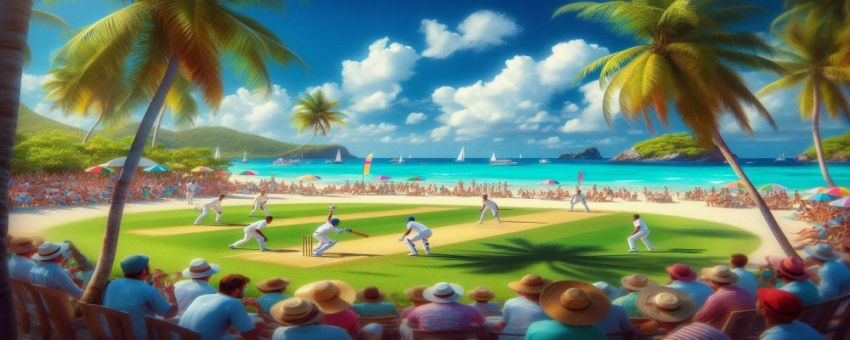
Few places in the world can claim cricket grounds with such breathtaking scenery. Matches often take place near sun-kissed beaches, with the turquoise waters and golden sands providing a postcard-perfect backdrop. Whether it’s a casual local game or a high-stakes international match, the natural beauty of the Caribbean makes cricket here a feast for both the eyes and the spirit.


The Party Atmosphere

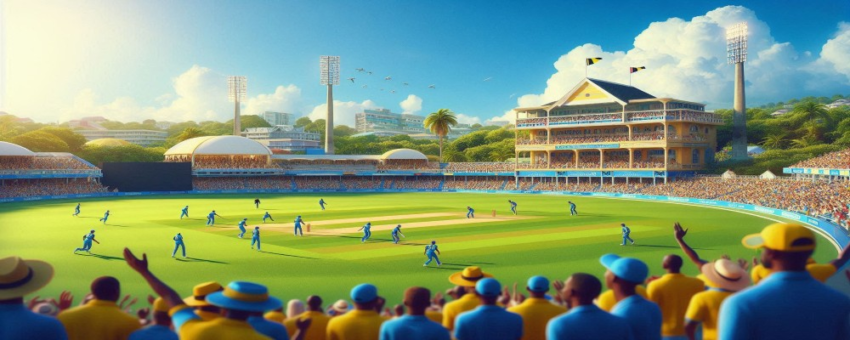
Cricket in the Caribbean is not just about the action on the pitch—it’s a festival. Fans bring music, dancing, and a carnival-like energy to the stands. Steel drums, soca, reggae, and calypso music pulse through the stadiums, turning every game into a lively, joyous experience. Even during tense matches, there’s laughter, singing, and celebration—a reminder that cricket here is as much about culture as it is about competition.


The Fans: Heart and Soul of the Game

The West Indies’ fans are passionate, knowledgeable, and full of character. They live and breathe cricket, and their energy is contagious. Whether cheering for a hometown hero or a national star, they turn every match into a communal celebration, showing how deeply cricket is woven into the Caribbean identity. The connection between players and fans is personal and intense—one reason why visiting a Caribbean cricket ground feels unlike any other sporting experience.


Why Caribbean Cricket Stands Out

It’s the blend of athleticism, artistry, culture, and celebration that makes Caribbean cricket truly unique. Here, the game is alive with music, color, and community spirit. It’s not just a match—it’s a festival that brings together history, identity, and joy, making it a sporting experience that leaves a lasting impression on anyone lucky enough to witness it.


Caribbean cricket isn’t just about who wins or loses—it’s about living the game, celebrating culture, and feeling the pulse of the islands with every ball bowled and every six struck.

Leave a Reply Cancel reply

Your email address will not be published. Required fields are marked *

Keep Updated Subscribe to Our Blog

Don't Want to Miss an Article Subscribe to Stay Updated.

Subscribe to Keep Updated
Loading...

Welcome to The Third Empire-Caribbean Cricket Blog

Posted on August 22, 2025September 5, 2025 by Harold Gittens
Two cricketers sprint on field, bats in hand, showing dynamic sports action.

The History of West Indies Cricket

Historical Background of Cricket in the West Indies

The story of cricket in the West Indies cannot be separated from the history of the region itself. Colonialism, slavery, and the plantation economy all played a role in shaping both society and the game that would become a passion for generations of Caribbean people.

Colonial Beginnings

In 1492, Columbus’s expedition reached the Caribbean, marking the beginning of European colonization of the “New World.” The first British settlement came in 1609 when shipwrecked colonists bound for Virginia landed in Bermuda. Soon after, colonies were established across the Caribbean: St. Kitts in 1623, Barbados in 1628, and later Antigua, Montserrat, Nevis, and others. Sugar plantations quickly dominated the economy, worked by enslaved Africans brought in large numbers.

By 1655, the British had seized Jamaica from Spain, and by the late 1600s, their territories in the region included Jamaica, Barbados, Bermuda, the Bahamas, and several Leeward Islands. Other territories, such as Dominica, Grenada, and St. Vincent, were later ceded to Britain after conflicts with France, while Trinidad and Tobago, Guyana, and the Virgin Islands were eventually added through conquest or treaties.

It is not known exactly when cricket was first played in the Caribbean, but it is widely assumed that the early British settlers introduced the sport during these centuries of colonization.

Slavery, Emancipation, and Society

The plantation economy thrived on the backs of enslaved Africans. In Jamaica, for example, by 1800, enslaved people outnumbered their white masters ten to one, leading to numerous revolts between the 17th and 19th centuries. Similar uprisings occurred in Guyana and elsewhere.

The British Parliament outlawed the slave trade in 1807 and abolished slavery across the empire in 1834, followed by a short-lived apprenticeship system that ended in 1838. Plantation owners were compensated, but freed Africans often faced poverty and limited opportunities. To fill the labor gap, indentured workers were brought from India, China, and other regions, creating the ethnic and cultural diversity that still defines the Caribbean today.

The Growth of Cricket

Against this backdrop of colonization and emancipation, cricket began to take hold. In the 19th century, inter-colonial matches were played sporadically due to the difficulties of travel between islands. By 1890, only ten such matches had been played, involving Barbados, Trinidad, and British Guiana.

The first recognized first-class match in the region took place on 15–16 February 1865, when Barbados hosted British Guiana at the Garrison Savannah in Bridgetown. Barbados won by 138 runs in a low-scoring game. The rough playing conditions—uneven grass, coral-strewn pitches, and mangled cricket balls—were far from ideal, but the passion for the game was undeniable.

A return match was played in September 1865 in British Guiana, where the home side won by two wickets. Social activities surrounded these games, including river trips and community gatherings, reflecting how cricket was already beginning to weave itself into the cultural fabric of the Caribbean.

Tragically, during one such post-match excursion on the Essequibo River, a boat capsized at Koestrabraek Falls, leading to the deaths of seven people, including two players. Despite such tragedies, the seeds of West Indian cricket had been firmly planted.

Leave a Reply Cancel reply

Your email address will not be published. Required fields are marked *

Hey! I'm Harold G

Harold M Gittens

My Voice in the Game We Love

I am a Sales Executive and Life Coach by profession, but at heart, I have always been a student and admirer of cricket. This game has given us unforgettable memories, uniting people across cultures, generations, and nations. Over the years, cricket has evolved—new formats have emerged, new heroes have risen—but at its core, it remains the game we love.

Through this platform, I want to add my voice to the conversation. Beyond scores and statistics, cricket is about stories, lessons, and the emotions it stirs in all of us. Here, I invite you to join me for meaningful discussions—about the sport’s past, present, and future. Together, we can celebrate the legends, debate the changes, and reflect on what cricket truly means to us as fans and as people.

Because cricket is not just a game. It’s a mirror of life itself—discipline, resilience, passion, and joy all rolled into one.

Coming Soon-Life Coaching & Stress Management

Motivational Quotes

"They may forget what you said buy they will never forget how you made them feel."

"Trust takes years to build, seconds to break and years to repair."

"The only person you should try to be better than is the person you were yesterday."

Recent Posts

  • Has the Present Brazil World Cup Team Lost the Flair of Past Teams
  • The Oldest Players at FIFA World Cup 2026
  • What West Indies Have Done Well So Far in the T20 World Cup and What will Keep the Momentum Going.
  • T20 World Cup 2026: Five Strategies that Can Help West Indies Win the Present T20 World Cup
  • Where Is the Plan? The Missing Ingredient in West Indies Cricket

The Third Umpire

The Oldest Players at FIFA World Cup 2026

The oldest players at the 2026 FIFA World Cup include several legendary veterans who are still representing their countries on the biggest stage. FIFA confirmed that Scotland goalkeeper Craig Gordon […]

Online Courses & Training

Teach English Online and around the Globe- World TESOL Academy

World TESOL Academy – Accredited TESOL/TEFL Certificate
IAP Career College
Affordable Online Certificate Courses at IAP Career College

TheTEFL Institute -Teach Online -TEFL Courses and Jobs

Amazon Deals

Amazon Echo Studio (newest model), compact design, immersive spatial audio and Dolby Atmos, Designed for Alexa+, Glacier White
PURE CHAMP Mens 3 Pack Fleece Active Athletic Workout Jogger Sweatpants for Men with Zipper Pocket and Drawstring - Size S-3XL

Privacy Policy

  • West Indies, New Zealand meet in Sobers' country to celebrate him
  • Garry Sobers dies, aged 89
  • Greaves and King return for final two ODIs against New Zealand
  • Lennox stars again as New Zealand take series lead after West Indies collapse
  • New Zealand bowl; West Indies bring in Shimron Hetmyer after long layoff

Menu

  • Get Started Here
  • Join the Conversation
    • About
    • THINGS I LOVE TO DO
    • Did You Know
  • Third Umpire Blog
  • Our Services
    • Life Coaching & Stress Management
    • Get In Touch With Us
  • Shop Best Sellers
  • World Cup Football Facts
Copyright ©2025 The Third Umpire. All Rights Reserved.